
I. TỪ VỰNG (VOCABULARY):
| STT | Từ mới | Phân loại | Phiên âm | Định nghĩa |
| 1 | wrap | (v) | /ræp/ | gói |
| 2 | fertilizer | (n) | /ˈfɜːtəlaɪzə(r)/ | phân bón |
| 3 | overpackaged | (adj) | /ˌəʊ.vəˈpæk.ɪdʒd/ | được đóng gói quá nhiều |
| 4 | fabric | (n) | /ˈfæbrɪk/ | vải vóc |
| 5 | compost | (v) | /ˈkɒmpɒst/ | phân hữu cơ |
| 6 | melt | (v) | /melt/ | tan chảy |
| 7 | glassware | (VP) | /ˈɡlɑːsweə(r)/ | đồ thủy tinh |
| 8 | soak | (v) | /səʊk/ | ngâm |
| 9 | press | (v) | /pres/ | ấn |
| 10 | mixture | (n) | /ˈmɪkstʃə(r)/ | chất hỗn hợp |
| 11 | firmly | (n) | /ˈfɜːmli/ | chắc chắn |
| 12 | scatter | (adj) | /ˈskætə(r)/ | rải rác, phân tán |
| 13 | detergent | (adj) | /dɪˈtɜːdʒənt/ | chất tẩy rửa |
| 14 | stir | (v) | /stɜː(r)/ | khuấy |
| 15 | mankind | (n) | /treɪs/ | dấu, vết, vết tích, dấu hiệu |
| 16 | confirm | (v) | /kənˈfɜːm/ | xác nhận |
| 17 | deposit | (n) | /dɪˈpɒzɪt/ | tiền đặt cọc |
1. Passive forms:
– Present simple: am / is / are + pp
E.g: This room is cleaned everyday by my mother.
– Present progressive: am / is / are + being + pp
E.g: A new swimming pool is being built (by them)
– Present perfect: have / has + been + pp
E.g: Oil has been discovered at the North Pole.
– Past simple: was / were + pp
E.g: On our way home we were stopped by the police.
– Past perfect: had + been + pp
E.g: All the documents had been destroyed when we arrived.
– Past progressive: was / were + being + pp
E.g: Dinner was being cooked at that time.
2. Adjectives followed by: an infinitive, a noun clause:
a) Adjectives + (to – infinitive):
+ Động từ nguyên mẫu (to – infinitive) thường được sử dụng:
+ Sau các tính từ diễn tả phản ứng và cảm xúc như: glad, sorry, sad, delighted, pleased, happy, afraid, anxious, surprised, shocked, …
E.g: He’s afraid to stay home at night.
I’m very pleased to see you here.
– Sau một số tính từ thông dụng khác như: right, wrong, easy, difficult, certain, welcome, good, hard, dangerous, safe, …, và sau các tính từ trong cấu trúc enough và too.
E.g: He is difficult to understand.
The apples are ripe enough to pick.
– Sau tính từ trong cấu trúc câu nhấn mạnh với chủ ngữ giả it.
It + be + adjective + to – infinitive.
E.g: It’s interesting to talk to you.
b) Adjective + noun clause (tính từ + mệnh đề danh từ)
Một cách để paraphrase mệnh đề danh từ thường đi kèm với các tính từ diễn tả cảm xúc: sorry, afraid, anxious, worried, confident, certain, surprising,…
Subject + be + adjective + noun clause (that – clause)
E.g: I am delighted that you passed your exam.
III. BÀI TẬP ÁP DỤNG (Exercise):
Exercise 1: Read a guide on how to recycle glass. Look at the instructions, rewrite them in the passive form and put the pictures in the correct order:
a) Break the glass into small pieces.
=> The glass is broken into small pieces.
b) Then wash the glass with a detergent liquid.
=> ___________________________________________________________.
c) Dry the glass pieces completely.
=> ___________________________________________________________.
d) Mix them with certain specific chemicals.
=> ___________________________________________________________.
e) Melt the mixture until it becomes a liquid.
=> ___________________________________________________________.
f) Use a long pipe, dip it into the liquid, then blow the liquid into intended shapes.
=> ___________________________________________________________.
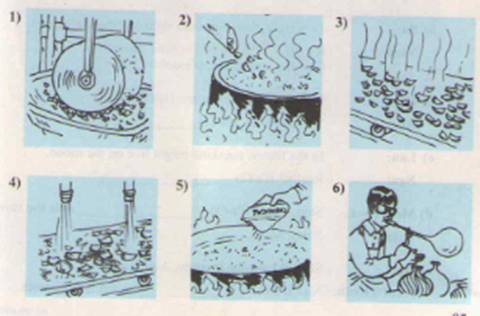
Exercise 2: A famous inventor, Dr. Kim, is going to build a time machine. One of his assistants, Hai, is asking him questions about the invention. Complete the dialogue. Use the correct form of the verbs in brackets:
Hai: When (0) will the project be started, Doctor? (start)
Dr. Kim: Very soon.
Hai: Many people want to see the time machine.
Dr. Kim: Yes. It (1) __________________to the public when it is finished. (show)
Hai: (2) _____________ it _________by the end of the year, Doctor? (build)
Dr. Kim: I’m afraid not, but it (3) _____before Tet. (finish)
Hai: (4) __________ it _________by you? (make)
Dr. Kim: No, I need you to build it. When can you start?
Hai: Let’s begin tomorrow.
Exercise 3: Complete the dialogues. Use the words in the box:
| easy / understand dangerous / go difficult / followhard / believe important / wait |
a) Ba: Turn right, then left, then right and then left again.
Nam: It’s (0) difficult to follow your directions.
Can you start again, please?
b) Mr. Dao: Can you do the exercise, Hoa?
Hoa: Yes, Mr. Dao. It’s (1) __________________________.
c) Lan: In the future, mankind might live on the moon.
Nga: Really? It’s (2) ________________________________.
d) Mrs. Thoa: Stop, Tuan! It’s (3) _______________________.
Tuan: Sorry, Mom.
e) Hoa: Should I stir the mixture, Aunt Thanh?
Aunt Thanh: No, It’s (4) __________________ for five minutes.
Exercise 4: Complete the letter. Use the correct forms of the verb be and adjectives in the box:
Dear Nam,
Your grandfather and I (0) are delighted that you passed your English exam. Congratulations!
Aunt Mai (1) ________________ that you remembered her birthday last week. She told me you gave her a beautiful scarf.
I (2) ______________ that your mother is feeling better. Please give her my love.
We’re looking forward to seeing you in June. However, grandfather (3) ______________ the day is wrong. (4) ________ you _______ that you’re arriving on Saturday 20th?
I (5) ________________ that there are no trains from Ha Noi on Saturday.
Write soon and confirm your arrival date and time.
Love,
Grandma
